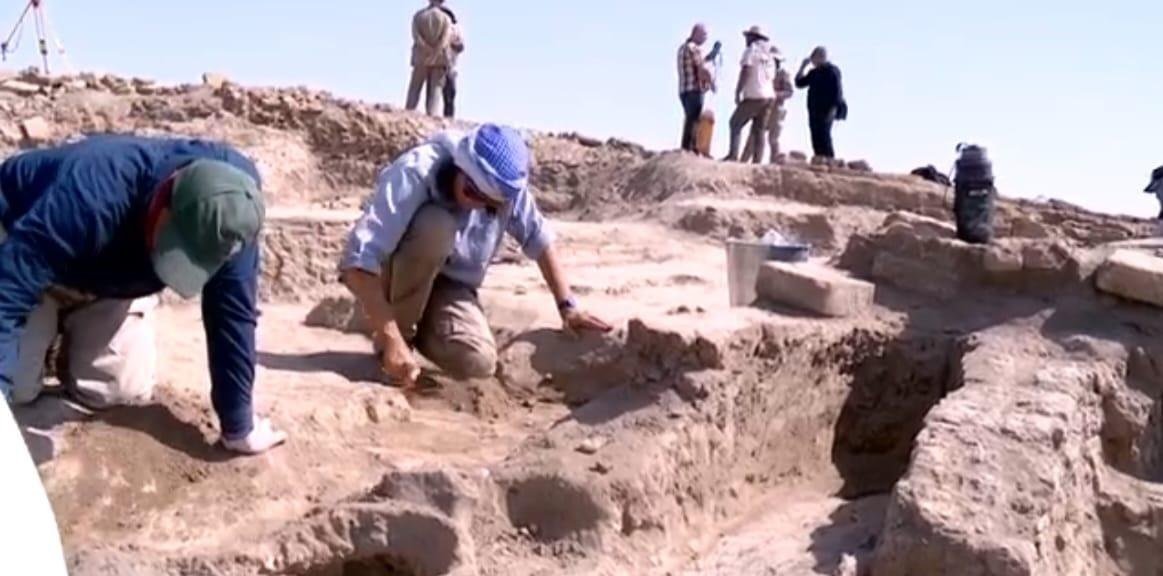
The Antiquities Inspectorate in Dhi Qar Governorate confirmed, on Sunday, the arrival of seven foreign and international missions to the governorate to excavate a number of archaeological sites, noting that the inclusion of the sites on the World Heritage List has contributed to attracting more international missions.
The Director of the Dhi Qar Antiquities Inspectorate, Shamil Ibrahim, said, "Nasiriyah Governorate is considered the archaeological capital of Iraq due to its vast cultural heritage, which includes more than (1,200) archaeological sites and cities." He explained that "the inclusion of sites such as Eridu, Ur, and the Central and Southern Marshes on the World Heritage List has encouraged international missions to come to Dhi Qar to conduct excavation work, study the antiquities, and uncover their cultural secrets."
He added, "Among the most prominent missions that have begun their work are the Russian mission headed by Alexei at the archaeological site of Al-Duhaila, the French mission headed by John at Tell Jabra, and the American mission at the site of Lagash, in addition to the Italian mission at Tell Zarghal, and the British Museum mission at Tello (the ancient city of Karsu)." He noted that "another French mission has begun its work at Tell Umm al-Ajaj, the first of its kind in the province, while the remaining missions continue their previous excavation work."
For her part, archaeological excavator Widad al-Araji explained that "Iraqi archaeologists constitute an essential part of the work of foreign missions, as they are the official body authorized by the General Authority for Antiquities and Heritage," noting that "Iraqi cadres are responsible for documenting and photographing archaeological artifacts and sites, and using geophysical survey equipment to determine layers and locations." Al-Araji explained that "the sites in the south are not limited to the Sumerian era, but extend back to the Babylonian and Akkadian eras, which witnessed the establishment of cities affiliated with those ancient states." She emphasized that "recent years have witnessed an increase in the number of foreign excavation missions, thanks to the efforts of the General Authority for Antiquities and the Dhi Qar Inspectorate in attracting new excavation teams in the cities of southern Iraq."
Dhi Qar receives new international missions as part of archaeological excavation projects.