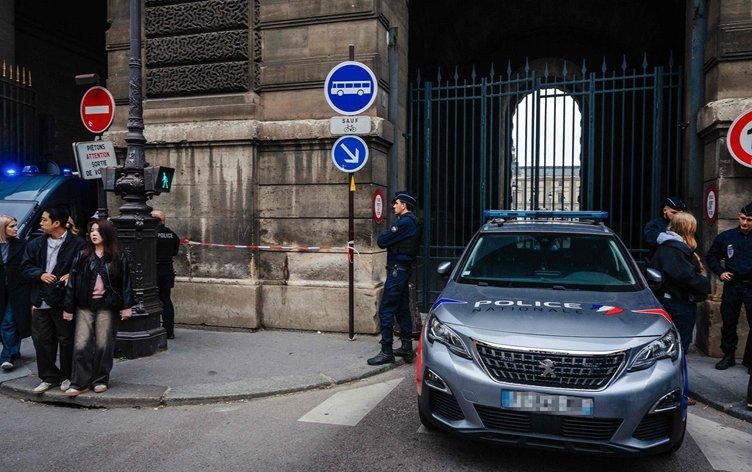
French police were searching on Monday for four thieves who stole "priceless" jewelry from the Louvre Museum in Paris on Sunday.
The theft, which bears the hallmarks of organized crime, occurred in broad daylight at the world's largest museum, which welcomes approximately nine million visitors annually and houses 35,000 works of art across 73,000 square meters.
The operation has attracted widespread international attention, sparked political controversy in France, and reopened the debate about museum security, which, according to Interior Minister Laurent Nunez, faces "significant weaknesses."
The case is being monitored by approximately 60 investigators from the Paris Judicial Police's Brigade for the Prevention of Crime (BRB) and the Central Office for the Fight against Trafficking in Cultural Property.
The theft occurred between 9:30 and 9:40 a.m. (7:30 and 7:40 GMT) using a truck equipped with a crane parked next to the quayside of the River Seine. The thieves used the crane to climb to the first-floor window and smashed it with a portable shearing machine. They entered the Apollon Hall, which houses the French Crown Jewels, and smashed two highly protected showcases containing the jewels.
The French Ministry of Culture stated that the thieves stole eight pieces of "priceless heritage value," noting that a ninth piece, the crown of Empress Eugénie, wife of Napoleon III (who was Emperor from 1852 to 1870), was dropped by the thieves as they fled.
Laure Picot, the public prosecutor in Paris, said the four men were "masked" and fled on motorcycles. A search is underway for them.
Among the eight stolen jewels, all dating back to the 19th century, is a ruby necklace belonging to Queen Marie-Amélie, wife of King Louis-Philippe I, composed of eight rubies and 631 diamonds, according to the Louvre website.
The thieves also stole an emerald necklace from a set belonging to Napoleon I's third wife, Marie-Louise, which contained 32 emeralds and 1,138 diamonds. Empress Eugenie's crown held approximately 2,000 diamonds.
Nunez said the theft lasted "seven minutes" and that the perpetrators were "experienced" thieves, who may have been "foreigners" and "possibly" known for committing similar acts.
The Ministry of Culture indicated that the swift intervention of museum staff prompted the thieves to "flee, leaving their equipment behind."
Since it is virtually impossible to sell the stolen jewelry as is, Prosecutor Picot suggested two hypotheses: either the thieves were acting "for the benefit of a specific party," or they wanted to steal precious stones "for money laundering."
The robbery, the first at the Louvre since 1998, has reignited debate in France about the security of museums, which have become targets for criminal groups due to their artistic treasures and the fact that they are less protected than other institutions such as banks.
French museums have recently been the target of robberies and burglaries, highlighting potential shortcomings in security and surveillance systems.
In mid-September, gold samples estimated to be worth around €600,000 were stolen from the National Museum of Natural History in Paris.
Also in September, a museum in Limoges, central France, one of the leading ceramics museums, was robbed, with losses estimated at €6.5 million.
When asked about a possible flaw in the Louvre's surveillance system, the Interior Minister indicated that museum security is fragile.
"We know very well that there are significant vulnerabilities in French museums," Nunes said, noting that a security plan recently launched by the Ministry of Culture "did not exclude" the Louvre.
French President Emmanuel Macron pledged in January to restore and expand the Louvre Museum after its director expressed concern about its deteriorating condition.
The theft sparked a backlash in France, which has been embroiled in a political crisis for months.
The Ministry of Culture explained that the alarms on the outer window of the Apollon Hall, as well as on the two highly protected facades, went off simultaneously during the robbery.
"This is an unbearable insult. How long will the collapse of the state continue?" said Jordan Bardella, leader of the far-right National Rally party.
Laurent Wauquiez, leader of the right-wing Republicans group in the National Assembly, said, "France has been plundered. We must protect what is most precious to us: our history."
Macron pledged on Sunday that authorities would "find the stolen items and bring the perpetrators to justice."
France searches for thieves who stole "priceless" jewelry from the Louvre Museum