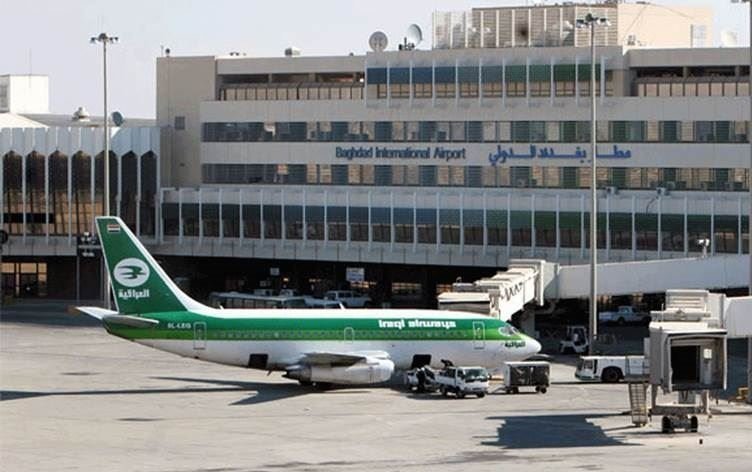
The Iraqi Cabinet approved a project to rehabilitate, develop, and operate Baghdad International Airport through a partnership with a global private sector operator.
This came, according to a statement issued by the Prime Minister's Media Office on Tuesday, October 28, 2025, "due to the need to develop services at Baghdad International Airport, the necessity of aligning with international standards in terms of aviation safety and security, the decline in the presence of international airlines, and because ensuring these standards requires a specialized and efficient management and operator."
The statement emphasized that "achieving all of this requires significant expenditures," therefore, "in order to improve the current state of the airport and bring it up to standards befitting Iraq's reputation, the Cabinet approved the project to rehabilitate, develop, and operate Baghdad International Airport through a partnership with a global private sector operator."
The statement explained that "a contract was previously signed with the International Finance Corporation (IFC) in late 2023 to act as a consultant to the government, with the aim of attracting specialized international companies and preparing the airport's investment prospectus for investment." It further stated that "14 consortia of various nationalities from around the world submitted bids to develop and operate the airport. After analyzing the submitted bids, the consultant disqualified four consortia for failing to meet the requirements in terms of experience and financial capacity."
The statement indicated that "the Airports Department at the Ministry of Transport launched a tender in May for the ten consortia that had passed the prequalification stage. A government committee, chaired by the Undersecretary of the Ministry of Planning and including relevant members from the Ministry of Transport, was formed to review the Requests for Proposals (RFPs) submitted by these consortia, in the presence of the consultant." It noted that "a number of consortia withdrew because they were unable to meet all the requirements, reducing the number of consortia to five. Some of these then merged, leaving three consortia with the capacity to submit both technical and commercial bids."
The statement clarified that "the three consortia are: the CAAP consortium, comprised of Corporation America Aviation and Amwaj International; the ASYAD consortium, comprised of YDA Insaat, Lamar Holding, Dublin Airport Authority, and Top Engineering Corporation; and the ERG International UK consortium, which includes Terminal Yapi and ERG Insaat." It further noted that "after analyzing the technical bids, the ERG International consortium was disqualified for failing to meet all the technical requirements."
He continued, "On October 19, 2025, the financial bids from the CAAP and ASYAD consortiums were received by the Contracts and Licensing Department at the Ministry of Transport, in the presence of representatives from both bidders. The financial bids were opened, and after analysis, the CAAP consortium was selected as it submitted a better financial offer. CAAP stipulated that the central treasury would receive 43.05% of the airport's total annual revenue for the duration of the concession, a higher percentage than the ASYAD consortium's offer of 38.05%."
The statement indicated that "the specific obligations of the winning bidder include the construction of a modern passenger terminal with a capacity of 9 million passengers in the first phase, increasing to 15 million in the second phase; the upgrading of runways and aircraft parking areas; the installation of 15 passenger boarding bridges; the construction of buildings for the Civil Aviation Authority and VIPs; the construction of a modern parking garage; and the rehabilitation of the air cargo terminal, fire suppression system, drinking water systems, and waste management facilities. The investor will also manage and operate the airport according to international standards and promote the development of air traffic."
It further noted that "the investor will be responsible for paying the salaries of airport staff and developing their professional skills through training, in addition to creating approximately 1,000 new direct job opportunities for every million new passengers. The investment in developing the airport will be around $764 million, with the government not spending a single dollar throughout the concession period."
The statement concluded by saying, “This investment contract is one of the best contracts since 2006 in terms of financial returns for the central treasury and transparency in the referral, noting that the Najaf, Karbala and Kirkuk airports that were referred for investment in previous governments did not achieve any financial returns for the treasury, while this project will provide thousands of additional job opportunities during the rehabilitation phase and beyond.”
The Cabinet approves a project to rehabilitate and operate Baghdad Airport in partnership with a global operator.